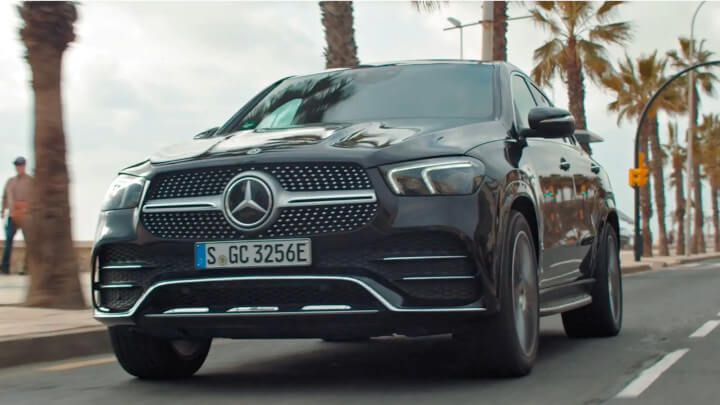
The Mercedes-Benz GLE Coupé (2025) is engineered with a 31.2 kWh gross (27 kWh usable) traction battery, delivering an official homologated WLTP electric range of 105 km. In real-world European driving conditions, drivers should anticipate approximately ~97 km in mild urban commuting, tapering down to around ~67 km during sub-zero motorway driving (130 km/h) due to cabin HVAC heating and aerodynamic drag. Replenishing the battery takes around ~20 minutes (10–80%) at 60 kW DC fast chargers, or ~2.6 hours via an 11 kW AC Wallbox.
LIVE ROUTE & WEATHER SIMULATION
Test This Vehicle on a Real Route
Calculate how ambient winter temperature, 130 km/h highway speeds, terrain elevation, and cabin heating impact the Mercedes-Benz GLE Coupé's battery in real time.
Equipped with a large 31.2 kWh pack (27 kWh net usable), the GLE Coupé sits in the upper percentile of European plug-in hybrids, offering true zero-emission range that rivals dedicated urban EVs.
Real-World Range Expectation
~67–97km realistic
While official WLTP laboratory figures state 105 km, drivers should anticipate approximately ~97 km in temperate urban commutes, and around ~67 km during sub-zero motorway trips with cabin heating.
Charging Infrastructure
11 kW AC Onboard
A standard 11/22 kW home wallbox will replenish the pack in approximately ~2.6 hours. Thanks to 60 kW DC fast charging support, quick roadside boosts from 10% to 80% can be completed in approximately ~20 minutes.
Daily Commute & Efficiency Verdict: For European motorists with typical round-trip daily commutes of ~30–40 km, the Mercedes-Benz GLE Coupé's 105 km electric range can comfortably cover ~3.1 days of routine driving on pure electricity before triggering the combustion engine.
Euro 6e-bis & Corporate Fleet Impact: With an official rating of 41 g/km CO₂ and 1.8 L/100km fuel consumption, this vehicle benefits from competitive tax brackets across major European markets. Under revised 2026/2027 Euro 6e-bis Utility Factor calculations, high electric range models like this retain substantially lower Benefit-in-Kind (BiK) and company car tax liabilities compared to older generation PHEVs.
EU 2026 / 2027 RegulationEuro 6e-bis Protected
Euro 6e-bis & Company Car (BiK) Tax Impact
With 105 km electric range and 41 g/km CO₂, this model qualifies for an estimated UK BiK rate of 5% (Low). Its high electric range cushions against upcoming EU Utility Factor calculation increases.
✓ Data verified from official manufacturer WLTP test sheets, European regulatory filings, and Euro NCAP crash databases.
Updated: October 2026 • Verified by PHEVs.eu Technical Team
EV-Database Standard
Charging Architecture & Electrical Ports
AC home wallbox charging curves and public DC rapid charging capabilities.
On-Board Charger
On-Board Charger (AC)
ON-BOARD CHARGER (AC)11 kW
AC Grid Phase Architecture3-Phase (Triphase)
CHARGING SOCKET (AC)Type 2 AC (Mennekes)
Domestic Socket (2.3 kW / 10A)~13.5 h
AC Wallbox (Max OBC)~2.5 h
Rapid Charging
DC Rapid Charging (CCS)
Max DC Peak Power60 kW
30% to 80% Fast Charge~20 min
Fast Charge Rate~158 km/h
DC ConnectorCCS Combo 2
Storage Architecture
BATTERY
Usable (Net) Capacity27 kWh
Nominal Gross Capacity31.2 kWh
Hybrid Buffer & Margin4.2 kWh (13%)
Battery Cell ChemistryNMC
Hybrid Powertrain & Battery Engineering
Transmission integration, pure-EV speed boundaries, and cell thermal management.
“18,563 miles logged (23.3 kWh usable battery). Summer EV range averages 54 miles (87 km, 2.2 mi/kWh), winter 44 miles (71 km). Depleted battery unladen gets 22 MPG (10.7 L/100km). Daily 30-mile commute with free work charging enables 1,500 miles per fuel tank.”
Own this vehicle? Help other drivers with your real numbers.