Do You Have to Plug In a PHEV? Fuel Economy with an Empty Battery (Charge-Sustaining Mode) & e-CVT vs P2 Drivetrain Realities
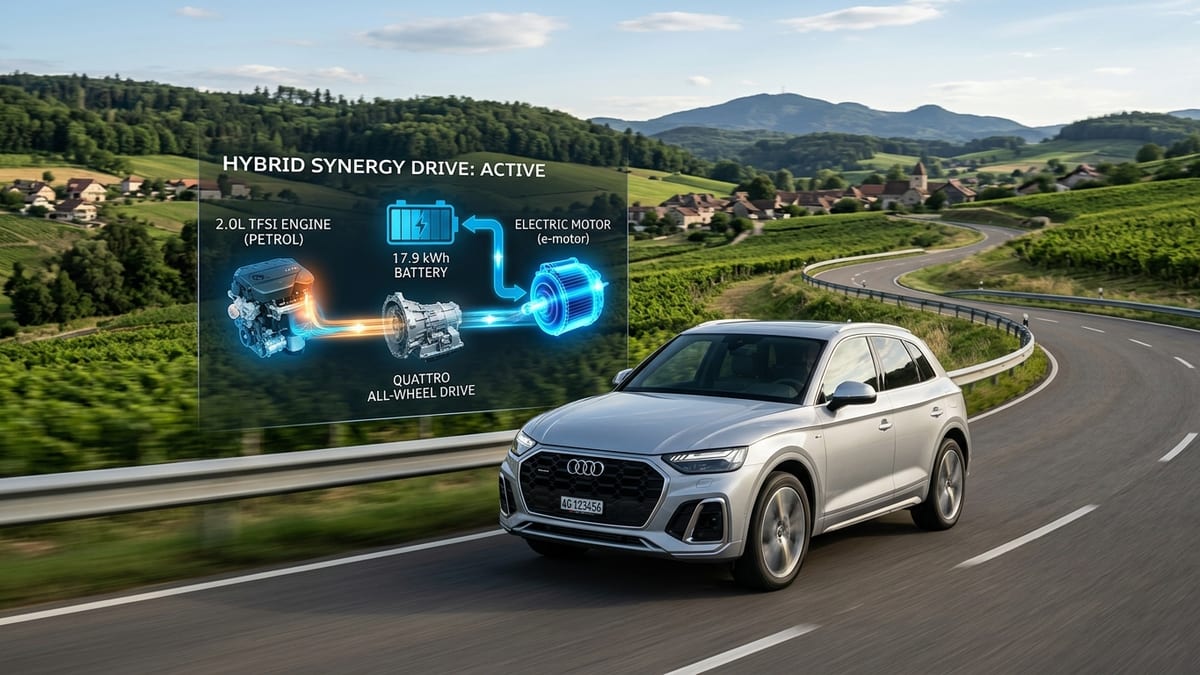
Can you drive a PHEV without ever plugging it in? An engineering exploration of the 200-400 kg dead battery weight penalty, Charge-Sustaining mode mechanics, Toyota e-CVT vs European P2 parallel transmission fuel economy, and mechanical risks.
One of the most widely searched and debated topics in the electrified automotive world is straightforward: "Can you drive a plug-in hybrid without ever plugging it in, treating it purely as a petrol car?"
The short answer: Yes, absolutely. The vehicle will run reliably and never leave you stranded.
However, the complete engineering and economic answer is far more nuanced: Driving a PHEV without plugging it in means hauling 200 to 400 kg of dead battery weight everywhere you go, and depending on your powertrain architecture, highway fuel consumption can climb well above expectations.
In this deep dive, we explore how Charge-Sustaining (CS) mode works, why e-CVT and P2 parallel hybrid transmissions behave dramatically differently with a depleted battery, and what long-term mechanical side-effects can occur.
1. The Battery is Never Truly at 0%: Buffer Architecture
When your digital dashboard shows "0 km EV range" or "0% battery", the high-voltage lithium traction pack is physically far from empty.
Automakers program an unreachable lower safety buffer (typically 15% to 25%) to prevent cell degradation caused by deep discharge.
- The powertrain shifts from Charge-Depleting (CD) mode to Charge-Sustaining (CS) mode.
- In CS mode, the car behaves like a standard full hybrid (HEV).
- Kinetic energy is recovered into this buffer during deceleration and braking, and the electric motor assists the engine during standing starts and overtaking.
2. The 200–400 kg Weight Penalty
Comparing a combustion SUV with its plug-in hybrid sibling reveals an inescapable mass difference:
- High-voltage traction pack: 150 – 250 kg
- Power inverters and electric motor assemblies: 80 – 120 kg
- Liquid thermal cooling circuits and chassis reinforcement: 40 – 60 kg
Overall, a PHEV carries 250 to 400 kg of additional ballast compared to a conventional petrol or diesel model. According to Newton's second law ($F = m · a$), accelerating this extra weight from traffic lights or up hills requires additional petrol fuel injection.
What is the Real-World Range of the BYD Seal U DM-i Boost?
Official WLTP ratings are measured in a controlled 23°C laboratory. Test how winter sub-zero temperatures (-10°C), sustained 130 km/h highway speeds, and terrain elevation impact actual battery range on your specific commute.
3. Transmission Architecture: e-CVT vs P2 Fuel Disparity
When the battery is exhausted, fuel efficiency depends almost entirely on the drivetrain configuration:
A. Power-Split Planetary e-CVT (Toyota / Lexus)
Toyota's planetary gear set links the combustion engine, electric motor, and generator without a traditional stepped gearbox.
- Depleted Performance: The car transforms into an exceptionally efficient full hybrid.
- City / Mixed: 4.8 – 5.5 L/100 km (51–43 MPG)
- 130 km/h Highway: 6.0 – 6.8 L/100 km (39–35 MPG)
B. P2 Parallel Hybrid (VW e-DSG, BMW ZF 8-Speed, Mercedes 9G-TRONIC)
European automakers place the electric motor between the engine and a multi-gear dual-clutch or torque-converter automatic transmission.
- Depleted Performance: On high-speed motorways, a small 1.5–2.0L turbocharged engine must pull a 2.1-ton vehicle without substantial electrical assist.
- City / Mixed: 6.5 – 7.8 L/100 km (36–30 MPG)
- 130 km/h Highway: Climbs to 8.5 – 10.2 L/100 km (28–23 MPG).
C. Dedicated Hybrid Transmission P1+P3 (BYD DM-i, Chery, Jaecoo)
Dedicated Hybrid Transmissions (DHT) operate primarily as series hybrids in city driving and lock the engine directly to the drive axle via a mechanical clutch on highways.
- City / Mixed: 4.9 – 5.4 L/100 km
- 130 km/h Highway: 6.8 – 7.8 L/100 km
4. Real-World Fuel Economy Table: Empty Battery
| Vehicle Model | Architecture | Battery Size | Depleted City Economy | Depleted 130 km/h Motorway |
|---|---|---|---|---|
| Toyota RAV4 Plug-in | Planetary e-CVT | 18.1 kWh | 5.0 L / 100 km | 6.4 L / 100 km |
| BYD Seal U DM-i | P1+P3 DHT | 18.3 kWh | 4.9 L / 100 km | 7.2 L / 100 km |
| VW Tiguan eHybrid | P2 (6-Speed DSG) | 19.7 kWh | 6.8 L / 100 km | 8.8 L / 100 km |
| BMW 330e Touring | P2 (8-Speed ZF) | 19.5 kWh | 7.2 L / 100 km | 9.2 L / 100 km |
| Volvo XC60 T6 Recharge | P4 Transverse Parallel | 18.8 kWh | 7.8 L / 100 km | 9.8 L / 100 km |
5. Mechanical Side-Effects of Never Charging
Relying exclusively on petrol in a PHEV introduces specific mechanical challenges:
- Crankcase Fuel Dilution: Short cold engine starts in city traffic cause unburnt fuel to bypass piston rings into the oil sump, degrading lubrication.
- GPF & Catalyst Loading: Gasoline particulate filters struggle to reach regeneration temperatures when the engine fires intermittently.
- Battery Buffer Stress: Continuously operating the battery pack at its lowest SoC range can increase internal cell resistance over time.
6. The Verdict: Should You Buy a PHEV Without Charging Access?
If you lack reliable charging access at home or the workplace, buying a plug-in hybrid solely for theoretical tax discounts may backfire at the fuel pump. A traditional self-charging full hybrid (HEV) like a Toyota RAV4 Hybrid or Honda CR-V will weigh ~300 kg less and deliver far better motorway fuel economy than an uncharged PHEV.
Stay Ahead on Next-Gen PHEV Releases & OTA Updates
Get notified when new European plug-in hybrid models premiere, along with real-world range benchmarks, battery chemistry insights, and software update breakdowns.
Related Models
Technical specs and live range simulations for models featured in this report
 80 km EV