What Euro 7 (EU 2024/1257) Fuel & Exhaust Rules Mean for PHEV Owners: Evaporative Limits, PN10, e-Fuels & Battery Warranty Explained
How does Euro 7 (EU 2024/1257) starting 29 November 2026 impact everyday PHEV drivers? Explaining the 1.5 g/test fuel evaporation limit, smoother PN10 winter cold starts, post-2035 e-Fuels exemption, and the mandatory 8-year battery health guarantee.
Introduction: What Does Euro 7 (EU 2024/1257) Starting 29 November 2026 Mean for a PHEV Owner?
The European Union's landmark Euro 7 emissions regulation (EU 2024/1257) officially becomes mandatory on 29 November 2026 for all newly type-approved passenger car models, and on 29 November 2027 for every new vehicle sold in European showrooms.
Whenever headlines mention "the Euro 7 fuel rules," everyday drivers understandably wonder: "Is the petrol at the pump changing?" Let us clear that up immediately: the unleaded E5/E10 petrol you buy at the station remains the same. Instead, Euro 7's fuel and exhaust rules transform how your Plug-in Hybrid's (PHEV) fuel tank traps petrol vapour, how your cold petrol engine behaves on freezing winter mornings, how synthetic e-Fuels keep hybrids legal beyond 2035, and how your high-voltage battery health is legally guaranteed.
Equally important for PHEV buyers is understanding a crucial distinction: while Euro 7 governs tailpipe pollutants, brake dust, and fuel evaporation, the rule that doubles official $CO_2$ ratings and reshapes company car taxes is the parallel Euro 6e-bis Utility Factor (UF) regulation.
To see how much electricity versus petrol your PHEV will consume on your daily commute, try our interactive Range Calculator.
Euro 6 vs. Euro 7: What Changes in Everyday Life for a PHEV Driver?
The comparison table below translates complex Brussels legislation into plain driver language, showing how Euro 7 directly impacts your daily driving comfort, maintenance wallet, and second-hand resale value:
| Regulatory Area | Old Rule (Euro 6) | New Rule (Euro 7 - EU 2024/1257) | What It Means for a PHEV Driver in Daily Life |
|---|---|---|---|
| Fuel Evaporation (Tank Vapour Leak) | 2.0 g / test | 1.5 g / test (-25% Stricter) | Petrol sitting in your tank for months of EV driving cannot evaporate; sealed tank flap waits ~3 sec to open. |
| Ultra-Fine Particle Limit (Exhaust) | PN23 (23 nanometres) | PN10 (10 nanometres) | Eliminates harsh, high-RPM cold-engine roaring when the petrol motor kicks in on winter mornings. |
| $NO_x$ (Nitrogen Oxide) Alignment | Petrol: 60 / Diesel: 80 mg/km | 60 mg/km for All Vehicles | Diesel PHEVs (e.g., Mercedes 300 de) must match petrol models even on short, cold urban trips. |
| Synthetic Fuel (e-Fuels) Pathway | Undefined | Post-2035 Exemption & Fuel Sensor | Future-proofs PHEV resale value; dedicated e-fuel hybrids remain legal beyond 2035. |
| Statutory Battery Health Guarantee | No Legal Floor | 5 Yrs 80% / 8 Yrs 72% SoH | Dashboard State-of-Health (%SoH) display becomes mandatory—protecting used PHEV buyers. |
| Brake Pad Dust (PM10 Limit) | No Limit | 3–7 mg/km for PHEVs/EVs | Stronger regenerative braking calibration; cleaner alloy wheels and brake discs lasting 100,000+ km. |
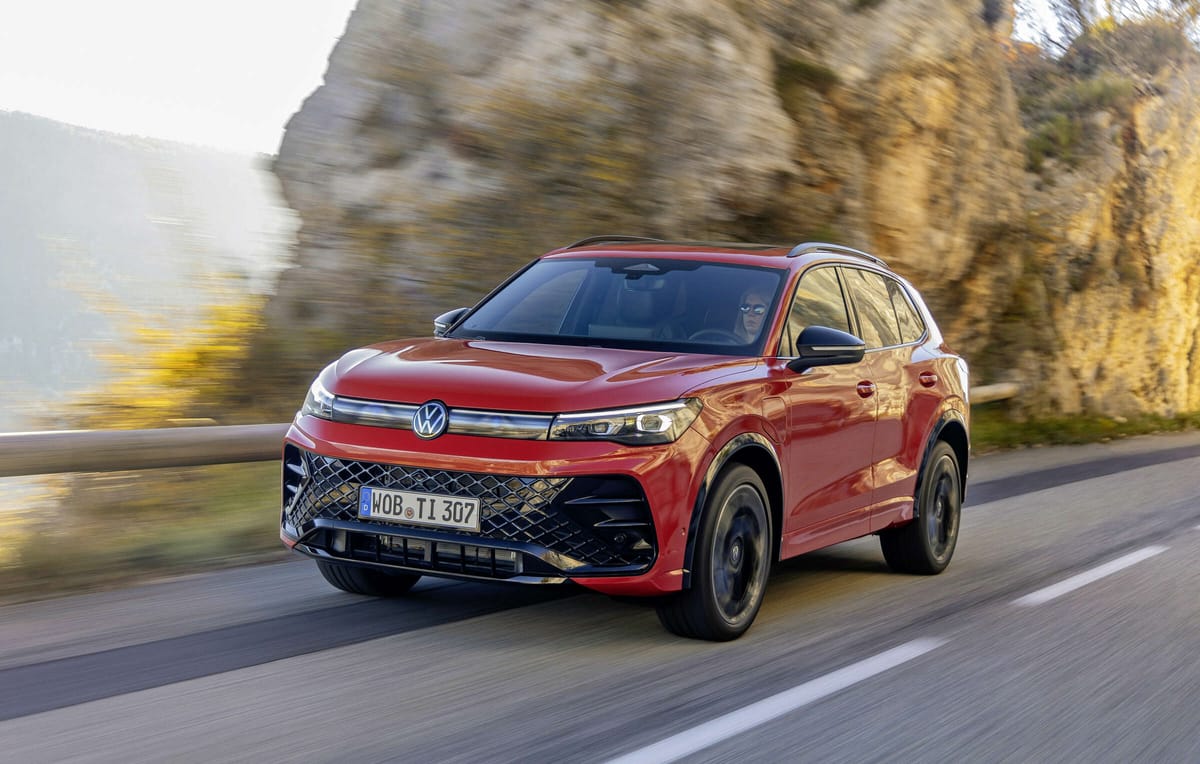 2025🏆 125 km EV
Tiguan eHybrid (2024+)
 2026
RAV4 Plug-in Hybrid (2026)
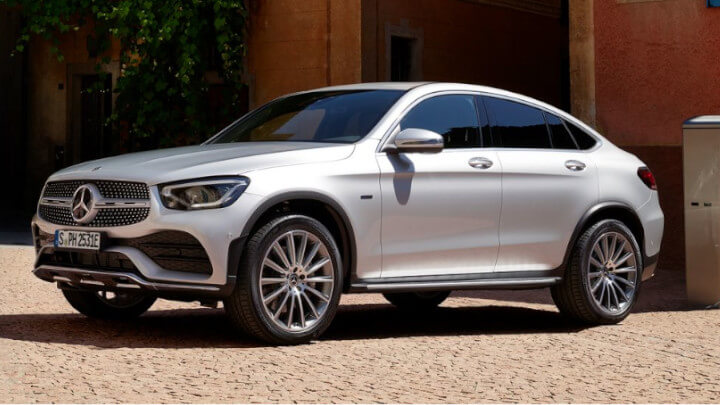 2025🏆 125 km EV
GLC Coupé
1. Fuel Evaporation (1.5 g/test): "Why Won't My Fuel Flap Open Immediately & What Happens to Old Petrol?"
The number-one habit that separates a PHEV owner from a conventional petrol driver is simple: if you plug in at home every night, you can easily commute for 3 to 4 months without burning a single drop of petrol. Yet those 45–50 litres of petrol sit sloshing inside your tank through warm days and daily drives.
Petrol is a volatile liquid that constantly evaporates into hydrocarbon vapour. Under Euro 7, the maximum amount of fuel vapour allowed to escape from a parked or refuelling car during a 48-hour sealed chamber test has been cut from 2.0 grams/test down to 1.5 grams/test. Here is what that means for you at the wheel:
- The "Depressurizing Fuel Tank, Please Wait" Message: To stop petrol vapour escaping into the air, PHEVs use a hermetically sealed, pressurized fuel tank (held at 35–40 kPa). When you pull into a petrol station and press the fuel flap release button on the dashboard, the flap does not pop open instantly—you wait 2 to 5 seconds while an electronic valve (FTIV) safely vents the vapour through a larger activated-carbon canister before unlocking the cap.
- Never "Top Off" After the First Pump Click: When refuelling a PHEV, always stop the moment the pump nozzle clicks off automatically. Forcing extra fuel into the filler neck to round up the price floods liquid petrol directly into Euro 7's oversized activated-carbon vapour canister. A saturated canister triggers a check-engine light and a €800 to €1,200 workshop bill.
- Automatic "Stale Fuel" Protection Mode: Petrol left sitting for more than 90–120 days oxidizes and loses octane quality. Modern Euro 7 PHEVs track fuel age and will automatically run the combustion engine briefly if you haven't refuelled in months, protecting the fuel injectors until fresh petrol is added.
[!TIP]
Smart Driver Tip for 100% Electric Commuters:
If you drive almost exclusively on electricity and only take long road trips a few times a year, keep your petrol tank between one-quarter and half full rather than brimmed. You save 25–30 kg of dead weight and ensure the petrol in your tank stays fresh.
2. PN10 (10 Nanometres) & 60 mg/km $NO_x$: How Will Your Car Behave When the Cold Engine Kicks In?
Every PHEV driver knows the most jarring moment of hybrid ownership: gliding silently on electric power on a freezing winter morning, pressing the accelerator to merge onto a motorway, and hearing the stone-cold petrol engine suddenly wake up and roar at high RPM.
From an engineering perspective, over 80% of a PHEV's tailpipe pollution happens during those first 60 seconds of a cold start, before the catalytic converter reaches operating temperature. Euro 7 tackles this head-on with two strict rules:
- From PN23 Down to PN10: Exhaust particle counting sensitivity drops from 23 nanometres down to 10 nanometres (PN10)—capturing ultra-fine soot particles emitted by direct-injection turbo petrol engines when cold.
- Unified 60 mg/km $NO_x$ Limit & Short-Trip Budget: Diesel PHEVs (such as the Mercedes-Benz 300 de range) lose their old 80 mg/km allowance and must meet the same 60 mg/km $NO_x$ cap as petrol models, including a strict "Cold Trip Emissions Budget" for short urban journeys under 10 km.
How This Rule Actually Improves Your Driving Refinement
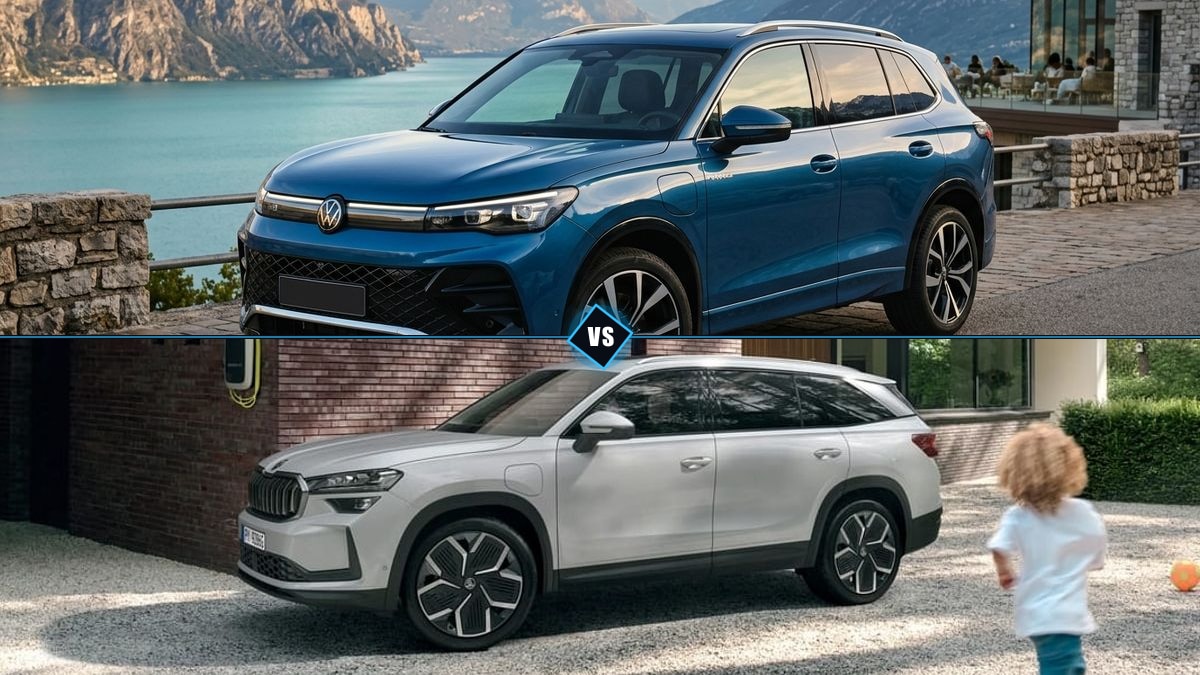
To pass PN10 cold-start tests, automakers (Volkswagen Tiguan eHybrid, Škoda Kodiaq iV, Toyota RAV4 PHEV (2026), and Mercedes-Benz GLC Coupé PHEV) have completely rewritten their hybrid engine-start software:
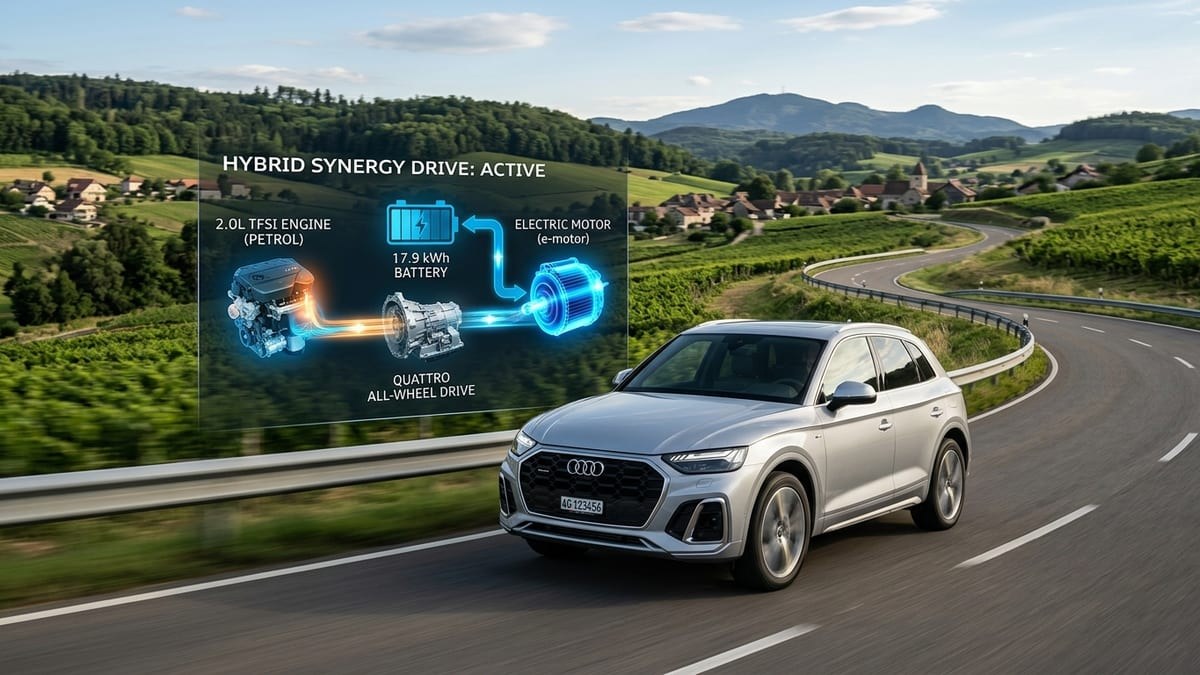
- No More Harsh Cold-Engine Revving: When the petrol engine starts cold in a Euro 7 PHEV, the software prevents it from jumping to high load for the first 30–40 seconds. Instead, the electric motor supplies the wheel torque you asked for, while the petrol engine purrs smoothly at low load solely to warm up its catalyst and oil. You get a quieter cabin and far less cold-start engine wear.
- Electrically Heated Catalysts (EHC): Many new PHEVs use energy from the high-voltage battery to pre-heat the exhaust catalyst to 350–400°C in seconds before the petrol engine even fires a cylinder.
What is the Real-World Range of the Volkswagen Tiguan eHybrid (2024+)?
Official WLTP ratings are measured in a controlled 23°C laboratory. Test how winter sub-zero temperatures (-10°C), sustained 130 km/h highway speeds, and terrain elevation impact actual battery range on your specific commute.
3. The E-Fuels (Synthetic Fuel) Pathway: "Will My PHEV Be Banned After 2035?"
A frequent concern among car buyers is: "With the EU targeting zero emissions in 2035, will my PHEV become illegal to drive or impossible to refuel?"
Euro 7 (EU 2024/1257) explicitly builds the technical and legal bridge for Carbon-Neutral Synthetic Fuels (e-Fuels):
- Zero Driving Bans on Existing Cars: The 2035 regulation applies exclusively to brand-new factory registrations from 2035 onward. Any PHEV you buy in 2026, 2027, or 2030 can be driven, serviced, refuelled, and resold on the used market for the rest of its mechanical life.
- What Are e-Fuels? Produced using renewable wind/solar electricity to extract green hydrogen ($H_2$) from water and combine it with captured atmospheric carbon dioxide ($CO_2$), e-petrol is chemically identical to conventional petrol. Because burning it releases only the exact $CO_2$ captured during its creation, it is 100% carbon-neutral and works in any PHEV tank without engine modifications.
- Post-2035 "Fuel Recognition Sensors": Euro 7 introduces the regulatory framework for dedicated post-2035 hybrid/ICE vehicles equipped with intelligent Fuel Recognition Sensors in the filler neck that verify whether certified carbon-neutral e-fuel has been pumped into the tank.
[!NOTE]
What This Means for Used Resale Value:
Combined with unrestricted access to European Low/Zero Emission Zones (ULEZ / ZBE) for 100+ km range PHEVs, the inclusion of e-fuels in Euro 7 protects the 5-year second-hand residual value of modern plug-in hybrids.
4. The Real Wallet Impact Is Euro 6e-bis (UF), Plus Euro 7's New Battery Warranty
As a buyer, here is the most important financial distinction to remember: the rule changing your company car tax is not Euro 7—it is the Euro 6e-bis Utility Factor (UF).
- The Euro 6e-bis Tax Shift: Using real-world fuel telemetry (OBFCM), the EU extended the laboratory test distance used to calculate PHEV $CO_2$ emissions from 800 km to 2,200 km (and 4,260 km in 2030). Consequently, older PHEVs with only 50–60 km of electric range saw their official $CO_2$ jump from 35 g/km to 80–95 g/km, losing tax breaks. To stay below 50 g/km $CO_2$ and keep low tax rates in 2026/2027, you must choose a next-generation PHEV with at least a 20 kWh battery and 100+ km WLTP range.
- The Best News in Euro 7 for Drivers — Mandatory Battery Health Warranty: Until now, battery degradation standards were left to individual manufacturers. Under Euro 7 (EU 2024/1257), every new PHEV sold in Europe is legally required to retain:
- At least 80% of its original battery capacity (%SoH) after 5 years or 100,000 km, and
- At least 72% capacity after 8 years or 160,000 km!
Furthermore, every car must feature a built-in on-screen Battery State of Health (%SoH) monitor accessible to the owner, taking all the guesswork out of buying or selling a used PHEV.
To calculate your exact company car or private tax savings under the new rules, visit our PHEV Tax Simulator, and check our PHEV Software Updates & Recall Tracker for the latest manufacturer bulletins.
Conclusion: 3 Golden Rules for PHEV Drivers in the Euro 7 Era
- Stop Pumping at the First Click: Because Euro 7's strict 1.5 g/test evaporative limit relies on a sealed tank and a sensitive carbon vapour canister, never overfill your fuel tank past the automatic nozzle shut-off.
- Enjoy Smoother Winter Cold Starts: Thanks to the PN10 particle rule, new PHEVs use electric motor torque to cushion cold petrol engine starts, eliminating harsh winter revving.
- Prioritize 100+ km Range Models: Choosing a 20+ kWh model like the Volkswagen Tiguan eHybrid, Toyota RAV4 PHEV (2026), or Škoda Kodiaq iV secures both Euro 6e-bis tax incentives and Euro 7's 8-year statutory battery durability protection.
Stay Ahead on Next-Gen PHEV Releases & OTA Updates
Get notified when new European plug-in hybrid models premiere, along with real-world range benchmarks, battery chemistry insights, and software update breakdowns.
Related Models
Technical specs and live range simulations for models featured in this report
125 km EVTiguan eHybrid (2024+)
102 km EVRAV4 Plug-in Hybrid (2026)
 123 km EV