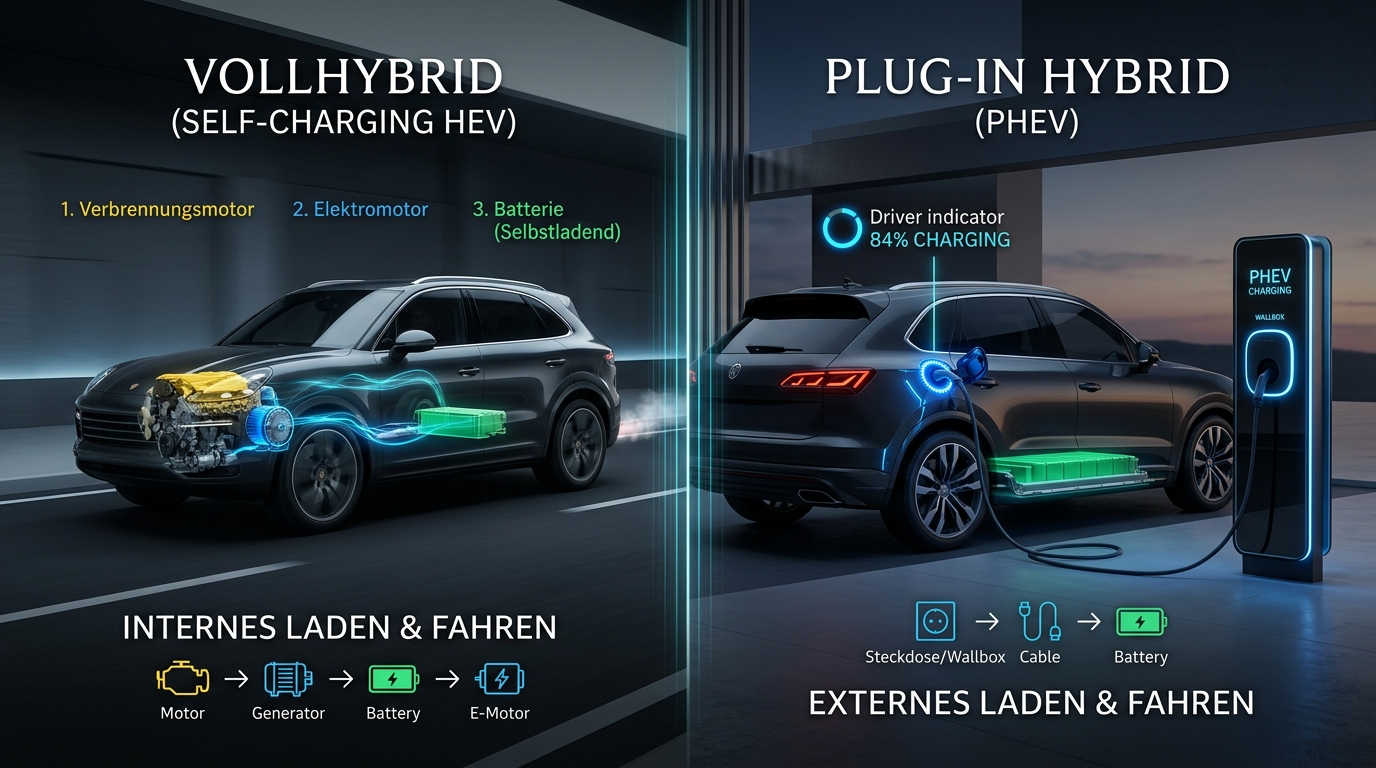
How Real-World PHEV Electric Range and Charging Costs Are Calculated: The Complete PHEVs.eu Simulator Guide
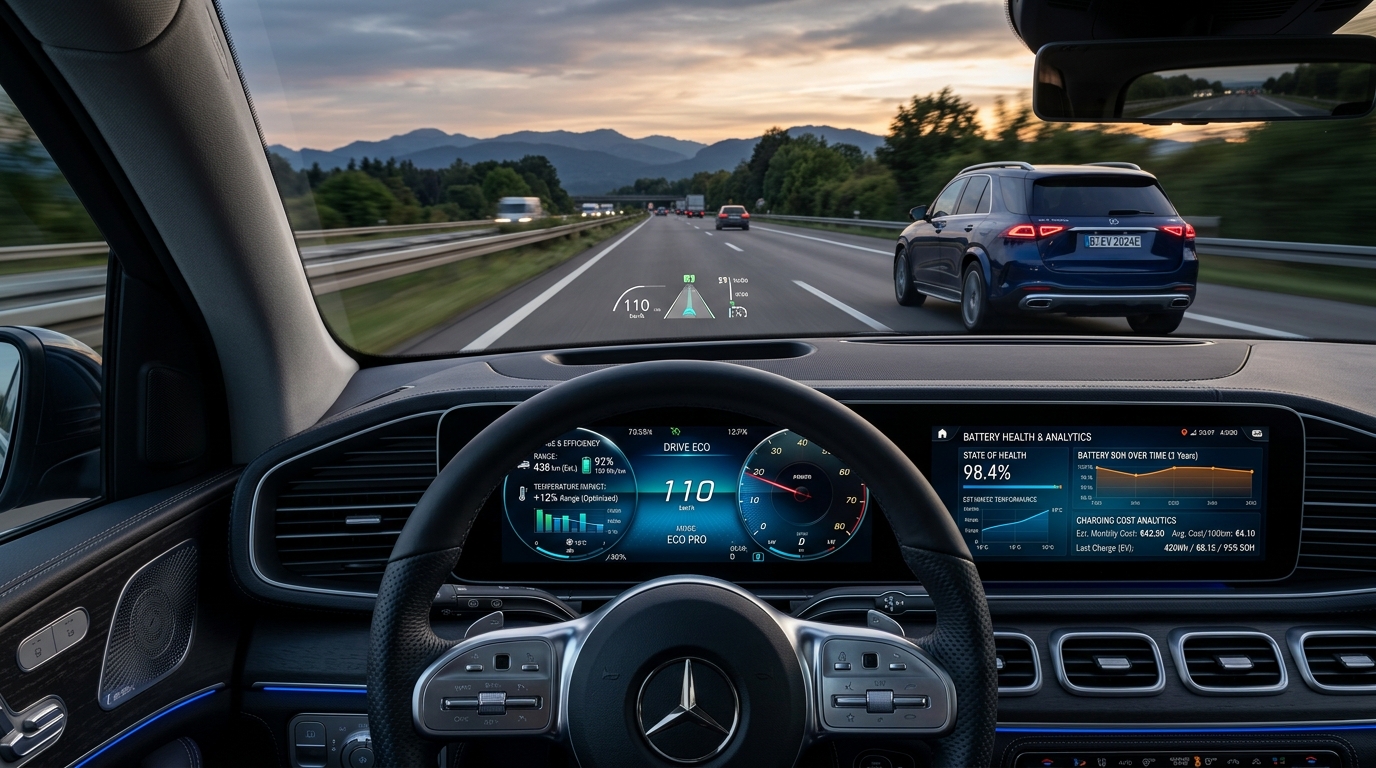
Why does real-world electric range differ from official WLTP laboratory ratings? A deep dive into ambient temperatures, aerodynamic drag, battery state-of-health (SOH), and charging cost dynamics using our interactive simulator.
For car buyers considering a Plug-in Hybrid Electric Vehicle (PHEV), one pressing question always takes precedence: "The brochure claims 80 km of electric range, but how far will it actually travel on a freezing highway in mid-winter?"
Official WLTP (Worldwide Harmonised Light Vehicles Test Procedure) laboratory ratings are recorded under strictly controlled test-bench conditions: a steady $23^\circ\text{C}$ room temperature, gentle acceleration curves, and climate control turned off. Real-world motoring presents a radically different scenario: fluctuating temperatures, aerodynamic drag at speed, auxiliary HVAC loads, and battery degradation over time.
The PHEVs.eu Interactive Range & Charging Cost Simulator was engineered to bridge this gap between official figures and daily reality. In this technical guide, we break down the thermodynamic, aerodynamic, and financial models that power our simulator.
1. Ambient Temperatures & Winter Reality: Why Cold Chills Battery Range
Lithium-ion battery packs store and release energy through electrochemical reactions. Their optimal operational window spans $15^\circ\text{C}$ to $25^\circ\text{C}$. When ambient temperatures drop below freezing, two physical constraints emerge:
- Increased Electrolyte Viscosity: In sub-zero weather, liquid electrolytes inside the cells thicken, elevating internal resistance and temporarily locking away 20% to 35% of theoretical energy capacity.
- Cabin Heating Demands (PTC Heaters): Unlike combustion vehicles that heat the cabin with byproduct thermal energy, a PHEV operating in pure electric mode must heat the interior using high-voltage PTC elements or heat pumps drawing $2,000$ to $5,000\text{ Watts}$. In a vehicle with a $15\text{ kWh}$ battery, running resistance heating can sap $3 - 4\text{ kWh}$ per hour.
The Simulator Solution: Pre-Conditioning While Plugged In
When you enable the "Pre-conditioned while plugged in" toggle in our simulator, you will observe a remarkable range recovery. When pre-heating your vehicle via its companion smartphone app while connected to a wallbox, the initial thermal energy demand is drawn from the electrical grid rather than the battery pack. You hit the road with a warm cabin and a conditioned battery pack, recovering 15% to 20% in usable cold-weather range.
2. Aerodynamic Drag ($F_d \propto v^2$) & Highway Cruising Speeds
In stop-and-go urban traffic, electric drivetrains excel thanks to regenerative braking (KERS). However, sustained highway driving shifts the primary consumption factor to aerodynamic drag.
Aerodynamic drag scales quadratically with vehicle velocity:
$$F_{\text{drag}} = \frac{1}{2} \rho v^2 C_d A$$
This aerodynamic physics model is directly reflected in our simulator:
- $100\text{ km/h}$ Cruising Speed: Air resistance is low; the electric motor delivers near 95%-100% efficiency.
- $120\text{ km/h}$ Cruising Speed: Typical European motorway speed; electric range decreases by approximately 15%.
- $140\text{ km/h}$ Cruising Speed (Autobahn): Aerodynamic drag nearly doubles; battery reserves deplete rapidly, producing an electric range penalty of up to 32%.
In the PHEVs.eu simulator, Highway Share (%) and Cruising Speed are dynamically combined to calculate accurate route consumption.
3. Driving Modes: Eco, Normal, and Sport
Our drive mode selector modifies throttle pedal mapping and regenerative braking intensity:
- Eco Mode (+6% Range): Softens initial pedal tip-in and optimizes regenerative harvesting during coasting.
- Normal Mode (1.0x): Baseline factory calibration.
- Sport Mode (-12% Range): Delivers instantaneous electric torque; aggressive acceleration spikes battery discharge rates.
4. Essential for Used Car Buyers: Battery Health (State of Health - SOH)
When evaluating a pre-owned PHEV, the battery's State of Health (SOH) is far more critical than odometer mileage alone. Over 3 to 4 years of DC fast charging or deep discharge cycles, usable cell capacity can decline to 90% or 80%.
Our Battery SOH module allows users to model:
- 100% (Brand New Vehicle): Full nominal capacity.
- 90% (3-4 Year Old Vehicle): Realistic degradation baseline for off-lease vehicles.
- 80% (Used / High Mileage): Enables used car buyers to preview real-world commuting feasibility before purchasing.
5. Charging Costs vs. Petrol Fuel Savings: Localized Market Analytics
A core feature of the PHEVs.eu calculator is automatic localization of currency and utility tariffs based on selected language:
| Country / Language | Currency | Home Electricity Tariff | Petrol Pump Price |
|---|---|---|---|
| 🇬🇧 / 🇪🇺 Europe (EN) | € | $0.28\text{ €/kWh}$ | $1.78\text{ €/L}$ |
| 🇩🇪 Germany (DE) | € | $0.36\text{ €/kWh}$ | $1.82\text{ €/L}$ |
| 🇵🇱 Poland (PL) | zł | $1.15\text{ zł/kWh}$ | $6.60\text{ zł/L}$ |
| 🇹🇷 Turkey (TR) | ₺ | $2.60\text{ ₺/kWh}$ | $44.50\text{ ₺/L}$ |
How Savings Are Computed
Consider a PHEV with a $15.5\text{ kWh}$ battery delivering $60\text{ km}$ of real-world electric commuting:
- Full Home Charge: $15.5\text{ kWh} \times 0.28\text{ €} = \mathbf{4.34\text{ €}}$.
- Petrol Equivalent: Traveling that same $60\text{ km}$ in a combustion SUV consuming $7.5\text{ L/100 km}$ costs: $4.5\text{ L} \times 1.78\text{ €} = \mathbf{8.01\text{ €}}$.
- Net Savings Per Charge: $+3.67\text{ €}$ in your pocket with every full battery cycle.
- Annual Savings (15,000 km/year): Daily commuters save over $\sim 920\text{ €}$ (or $28,000\text{ ₺}$) in annual fuel expenses.
Users can easily customize tariffs using the "Edit Tariffs" toggle to match their specific off-peak night rate or local fuel station.
6. Charging Durations: Standard Socket vs. Wallbox vs. DC Fast Charging
Our simulator inspects each vehicle's onboard charger (OBC) specifications:
- Home Socket (2.3 kW Schuko): Requires no electrical installation; fully replenishes a $15 - 20\text{ kWh}$ pack in $\sim 8 - 11\text{ hours}$ overnight.
- AC Wallbox (7.4 kW / 11 kW): Cuts charging time to $\sim 2.5 - 3.5\text{ hours}$.
- DC Fast Charging (CCS): On equipped models (such as BYD Seal U, VW Tiguan eHybrid, Mercedes GLC), charges from 10% to 80% in just 25 to 30 minutes.
Try the Simulator Live!
Evaluate over 120 PHEV models in our European database using the PHEVs.eu Interactive Range & Cost Calculator. Click the "Range Calculator" button in our top navigation bar to test any vehicle today.